
Short Message Analysis
Backchatter is Open
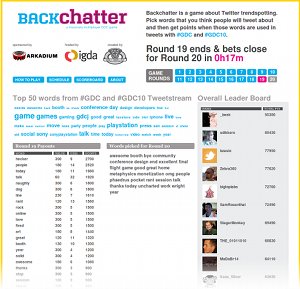 Round 19: Behold the penultimate round at GDC!That's right, Backchatter is now free software! After my colleagues and I at Local No. 12 wrapped up the game the Game Developers Conference this spring, we made the whole thing open source. You can find it on our SourceForge page. And check out our freshly completed documentation.
- Mike's blog
- Comments
- Read more


- 131263 reads
Raw Data From First 48 Hours of #iranelection
I've put together a .csv (comma-separated file) with the results I pulled off of Twitter for the first 48 hours of the Iranian election events. Be aware--it's about 20MB. Hopefully, many of you will find this useful in your own research. The columns are tweet id, date and time, text, profile image path, twitter username, twitter user id, and twitter user id of the immediate "reply to" (note that, in my graph analysis, I keep track of all @'s in the message, not just the first one as Twitter does. Only that first id is listed in the data file.)
- Mike's blog
- Comments
- Read more
- 15063 reads
Twitter Graph Analysis Results for Iranian Elections
If you've read my swineflu analysis, some of this should make sense. I ran a search on '#iranelection OR Tehran OR Ahmadinejad OR Mousavi' in Twitter for the period between Friday and Sunday evening. From the 79,957 results I got back, below is some graph analysis of what came out.
- Mike's blog
- Comments
- Read more
- 13815 reads
Twitter Analysis for GLS09
Here is the latest in my continuing series on analyzing Twitter conference backchannels by their hashtags and replies/retweets. This one, though, is a bit different and special... because I was actually at the conference! Below is my breakdown of Games + Learning + Society 2009 via the #gls and #gls09 hashtags.
- Mike's blog
- Comments
- Read more
- 14194 reads
Twitter Graph Analysis Results for #mit6
Because I've recently been... let's just come out and say obsessed with looking at the social relationships that seem to emerge from examining sociograms of Twitter users within the "channel" of a particular hashtag, here's another one I thought was interesting: Media in Transition 6, a.k.a. #mit6.
- Mike's blog
- Comments
- Read more
- 8211 reads
Twitter Graph Analysis Results for #mw2009
Just a quick post about another conference's Twitter backchannel I analyzed recently. Take a look at my posts on #swineflu and #09ntc to get a full picture of what I'm up to here. Basically, I'm looking at the network formed by replies and retweets in Twitter inside of a particular hashtag. Here, I'll go over the results of Museums and the Web 2009, a.k.a. #mw2009.
- Mike's blog
- Comments
- Read more
- 7655 reads
Early Notes on Conference Tweeting
I just did a run on the first two days of the 2009 Nonprofit Technology Conference using the tools I've been working on (see my post on #swineflu earlier this week.) Using the hashtag #09ntc, I parsed 3834 tweets, and I looked up the hubs and authorities, plus generated the graph of the largest strongly connected component within the larger directed graph created from all the "@" replies and retweets.
- Mike's blog
- Comments
- Read more
- 13903 reads
Twenty Four Hours of #swineflu
I've been doing more research on Twitter recently, mostly looking at back channels from conferences (more on that to come). I wanted to post up a quick analysis, though, on a recent story that blew up big--the Swine Flu outbreak (found in twitter, in part, via the #swineflu hashtag.)
- Mike's blog
- Comments
- Read more
- 14198 reads
Who Failed With #amazonfail?
I just read two very interesting articles from two commentators I respect immensely: Clay Shirky's The Failure of #amazonfail and Mary Hodder's Why Amazon Didn’t Just Have a Glitch. I won't do their arguments justice here, but I'll try to summarize as best I can.
- Mike's blog
- Comments
- Read more
- 9270 reads
The Social Media of Protest
I had an interesting experience today watching the various media assembled, largely through twitter, of the protest in 65 5th Ave. While I don't have much to say one way or the other on the event itself, it was fascinating to see the raw news feed come together and to get a sense of the spread of and reaction to the news of a noteworthy event.
- Mike's blog
- Comments
- Read more
- 6514 reads
tags
Copyright Mike Edwards 2006-2009. All content available under the Creative Commons Attribution ShareAlike license, unless otherwise noted.